
Crypto Transaction Fees Explained: Casino Withdrawal Costs
Learn how crypto transaction fees work, what drives them on Bitcoin, Ethereum and Solana, and how fees can affect casino withdrawal amounts and timing.
A crypto transaction fee pays for processing a transfer on a blockchain. Its size varies with the network, demand and transaction type. A casino's withdrawal deduction is separate, so blockchain costs alone cannot predict what a payout will cost.
For an adult comparing casino or sportsbook payouts, focus on the operator's deduction, what it covers, and the amount that reaches the receiving wallet. A low network fee can still accompany an expensive payout if the casino applies a fixed withdrawal charge. The distinction matters: one charge is tied to blockchain processing, the other to the operator's payout policy.
Table of Contents
- Typical Crypto Transaction Fees by Network
- How Crypto Transaction Fees Are Calculated and Why the Asset Changes the Bill
- What Makes Crypto Transaction Fees Rise and Fall
- Casino Withdrawal Charges Versus Network Fees
- Why an Approved Withdrawal Can Still Be Pending
- Checking Fees Before You Request a Casino Withdrawal
Typical Crypto Transaction Fees by Network
Reported network fees provide a starting point, not a withdrawal quote. The Solana Foundation's October 2024 network report published six-month average transaction fees of $0.02 for Solana, $3.58 for Ethereum, $0.22 for TRON, $0.13 for BNB Chain and $0.05 for Base.
These figures cover the same measurement window, which makes the historical comparison useful. They don't establish the cost of a particular casino payout, and they aren't a current price list.
Reported average transaction fees by network
| Network | Reported average fee | Measurement period |
|---|---|---|
| Solana | $0.02 | Six months covered by the October 2024 report |
| Ethereum | $3.58 | Six months covered by the October 2024 report |
| TRON | $0.22 | Six months covered by the October 2024 report |
| BNB Chain | $0.13 | Six months covered by the October 2024 report |
| Base | $0.05 | Six months covered by the October 2024 report |
| Bitcoin | Set by transaction size and chosen fee rate | No comparable average supplied for this window; chosen fee rate and available block space set the cost |
The table describes network activity, not an operator's payment policy. It doesn't establish whether a casino supports a listed network, absorbs its costs, or applies another deduction before releasing funds.
Newer median measurements discussed under casino charges show why these historical averages shouldn't become permanent labels. A median and an average also describe different things: an average can be pulled upward by expensive transactions, while a median identifies the middle observation. Neither measure guarantees the fee for a specific native-asset or token withdrawal.
Matching a benchmark to a payout
A useful comparison starts with the precise asset and network displayed in the cashier. An Ethereum-based token payout isn't automatically comparable with a native ETH transfer, even though both use the same blockchain.
The Ethereum withdrawal reference provides an asset-specific route for examining reported payout records. Its timing context should remain separate from the historical network averages in the table.
Benchmark rule: Compare the same asset, network, transaction type and measurement period. Treat every reported network fee as a snapshot, not a guaranteed deduction on a future withdrawal.
Bitcoin is deliberately left without a headline average here. Assigning it an unrelated figure would imply a like-for-like comparison that the reporting window doesn't support. Its chosen fee rate and the competition for block space are more useful when evaluating a pending payout.
How Crypto Transaction Fees Are Calculated and Why the Asset Changes the Bill
On Ethereum, total fee = gas used × gas price. Ethereum's gas documentation explains that the effective price combines a mandatory protocol-set base fee with a sender-selected priority fee, and that the base fee can rise or fall by as much as 12.5% per block.
Gas measures execution work, not the monetary value being transferred. That distinction matters for casino withdrawals because sending a native asset and transferring a token can require different amounts of work.
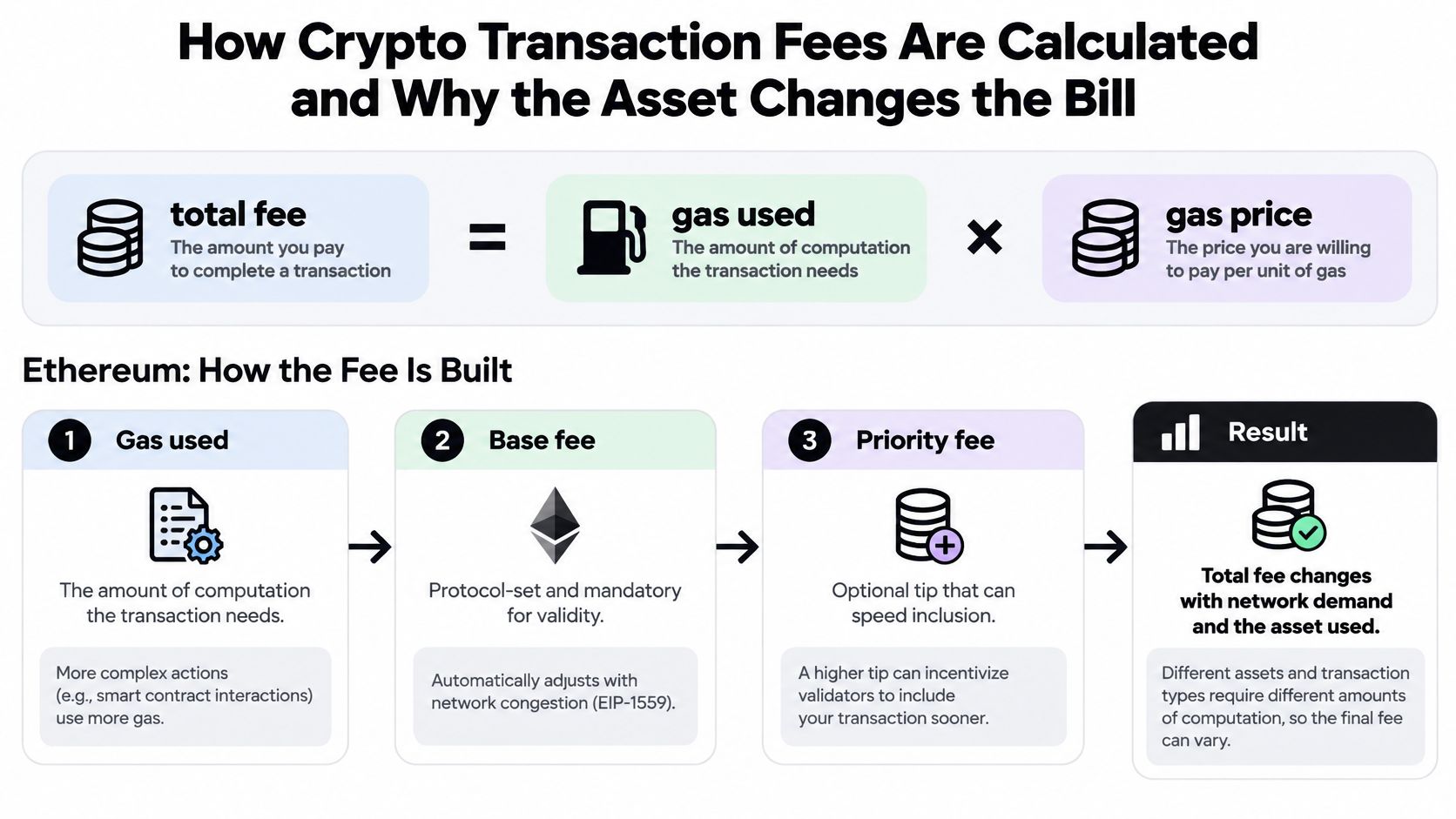
The calculation in practical steps
Execution determines the gas used. The transaction's instructions determine how much computation is needed. A straightforward native-asset transfer is different from a request that calls a token contract.
Network demand determines the base fee. The protocol adjusts this component as demand changes. Consequently, otherwise similar transfers can have different costs when submitted under different conditions.
The sender chooses a priority fee. This tip gives validators an incentive to include the transaction sooner. For an operator-originated withdrawal, the operator or its payment infrastructure makes that choice, rather than the receiving player.
Gas used is multiplied by the effective price. The resulting charge is the blockchain execution cost. The casino can absorb it, pass it through, or quote a separate withdrawal deduction under its own terms.
These steps explain why an approved withdrawal amount alone doesn't reveal the network bill. The relevant information includes what transaction the operator submits and how the operator handles the cost.
A worked Ethereum transfer
Ethereum's transaction documentation gives a standard transfer example using 21,000 gas, a 190 gwei base fee and a 10 gwei priority fee, producing (190 + 10) × 21,000 = 4,200,000 gwei, or 0.0042 ETH.
That is an illustrative calculation, not a live quote. Substituting a different effective gas price changes the result, and substituting a different transaction can change the amount of gas consumed.
The example also doesn't establish a dollar withdrawal charge. A fee denominated in ETH and a deduction displayed in a cashier's account currency are different measurements. A meaningful reconciliation keeps the units consistent and records any conversion the operator applies.
Why USDT and USDC need a separate comparison
An Ethereum token transfer calls a smart contract rather than merely moving native ETH. USDT or USDC withdrawals therefore generally require more execution than a basic native-coin transfer.
The token name alone isn't enough to compare costs. A stablecoin offered on different networks can involve different transaction mechanics, and the receiving wallet must support the selected network. A lower quoted fee is no advantage if the payout route doesn't match the receiving account.
A useful cashier comparison therefore identifies:
- Asset and network: The full payment route, not just the token ticker.
- Transaction category: Native-asset transfer or token-contract interaction.
- Cost treatment: Absorbed network cost, passed-through fee, or operator deduction.
- Net receipt: The amount expected to reach the receiving address.
A fee-free label may mean the casino adds no surcharge or covers the blockchain cost. It doesn't mean the underlying transaction consumes no network resources. Without an explanation of what the label excludes, the advertisement isn't enough to calculate the final payout.
What Makes Crypto Transaction Fees Rise and Fall

Bitcoin's daily average transaction fee reached $54.64 on December 22, 2017, compared with fees often between $5 and $20 during that year, according to the Bitcoin fee-market comparison. Bitcoin's price rose from approximately $1,000 in January to nearly $20,000 in December, as transaction demand grew beyond the practical capacity of its 1 MB block limit.
The fee increase reflected competition for limited block space. More users wanted transactions confirmed, and senders could offer higher fees to give their transactions priority. A busy block does not have room for every pending transaction, so fee offers help determine which transactions are included sooner.
The drivers behind a changing quote
- Overall demand: More competing transactions can raise the fee needed for prompt inclusion.
- Available capacity: Block-space and execution limits constrain how much work a network can process at a time.
- Transaction complexity: Contract calls can require more execution than straightforward asset transfers.
- Sender priority: The sender's fee choice affects how competitively the transaction is priced for inclusion.
Ethereum illustrates how congestion and computational work can affect costs differently. Crypto Research Report's transaction-cost analysis describes average Ethereum fees crossing $70 in May 2021, using Glassnode-based reporting, while complex actions such as token swaps or adding liquidity frequently cost over $100 during the final quarter of 2021.
Those complex-action figures describe computationally demanding activity, not ordinary casino withdrawal charges. Even on the same blockchain, a basic transfer and a contract interaction can require different amounts of execution, producing different fee profiles.
What this means for a withdrawal quote
A smaller payout can incur a higher network fee than a larger one if it is submitted during heavier competition or requires more execution. The payout amount alone does not determine the network cost. Timing, transaction type, available block space and the sender's fee choice all matter.
Scaling changes can reduce normal network costs, but a quote still depends on the conditions and fee policy in effect when a transaction is submitted. The casino may quote a variable cost, absorb it, or pass it through to the player. That policy determines how network conditions appear in the withdrawal amount, while the blockchain fee itself reflects the transaction and its place in the queue.
For a useful comparison, record when the quote appeared and whether it remained valid through submission. If the displayed deduction changes, checking whether the underlying network quote changed helps distinguish a variable fee from a separate operator charge.
Casino Withdrawal Charges Versus Network Fees
| Charge | Who sets it | Changes with network demand | What to check |
|---|---|---|---|
| Casino withdrawal deduction | The operator | Usually no, when fixed | Withdrawal terms and quoted deduction |
| Blockchain network fee | Network demand and fee choice | Yes | Transaction ID and fee rate |
| Absorbed network fee | The operator decides whether to cover it | The underlying cost changes | Whether the operator covers the network cost |
| Payment provider charge | The payment processor | Depends on provider pricing | Provider terms |
These charges have different sources. A fixed casino deduction can remain unchanged while a blockchain fee moves with network demand. A payment provider may also charge separately under its own terms.
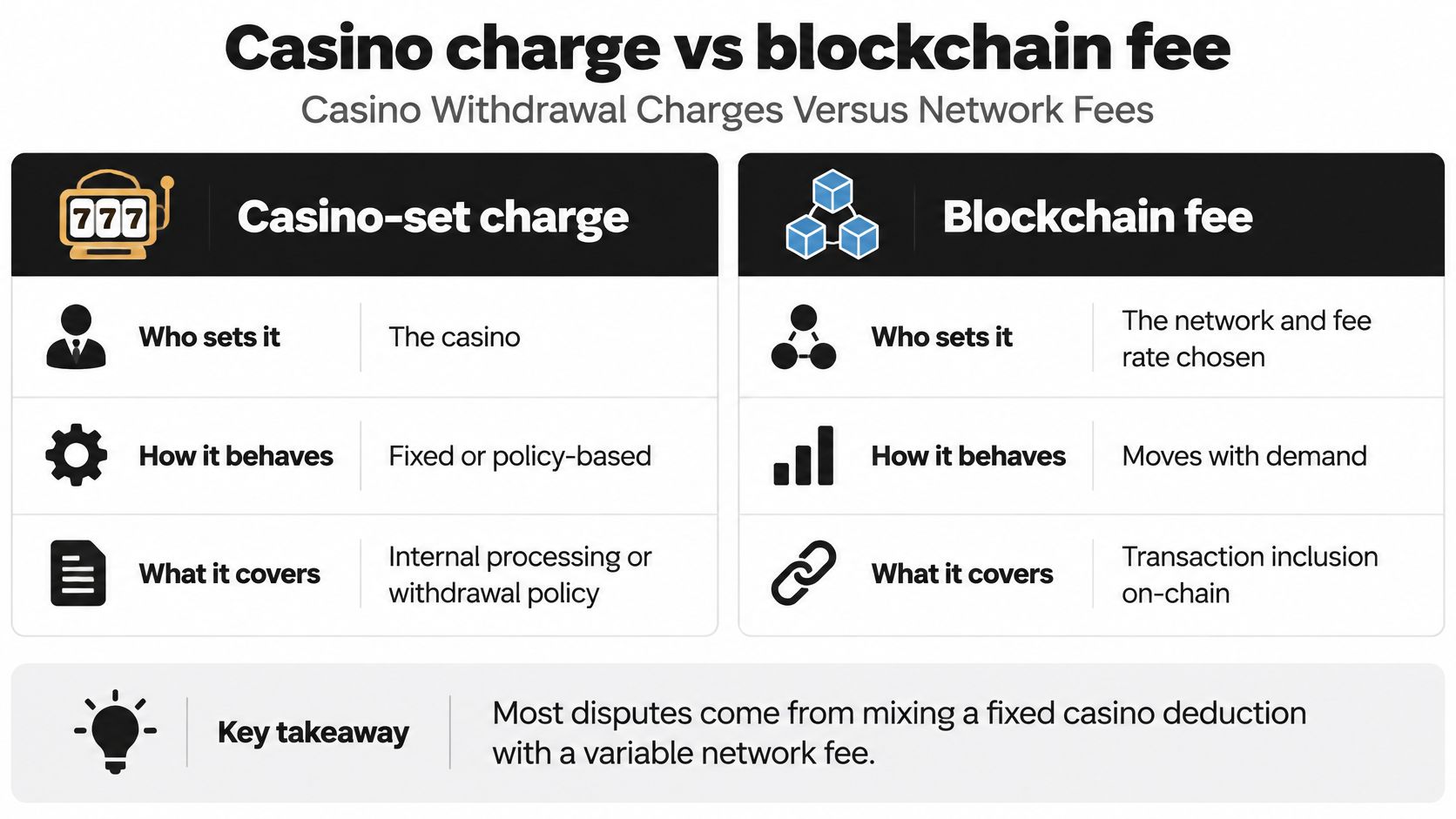
The fixed-fee trap
A fixed operator deduction takes a greater proportion of a small payout than of a large one, even if the blockchain transaction itself costs little. The arithmetic is direct: fixed deduction ÷ requested amount gives the share taken by that deduction. As the requested amount falls, that share rises.
The cheapest network may therefore still result in a costly withdrawal. Compare the amount requested with the amount received after the disclosed deductions.
Why network reputations become outdated
A published transaction-fee study found Ethereum's median fee fell from $3.786300 in 2024 Q1 to $0.012283 in 2026 Q1, a 99.68% decline. Solana's median fell 27.80%, from $0.000687 to $0.000496 over the same quarters.
These historical medians show that fee changes differ between networks. They are not casino quotations and do not establish which operator currently has the lowest withdrawal deduction.
The withdrawal fees and minimums guide explains how to compare a quoted charge with payout thresholds. Keep the asset, network, transaction type, amount and timestamp with the operator's displayed deduction. That record helps separate a network cost from an operator or provider charge, and makes the final amount easier to reconcile.
A displayed fee describes a term. A withdrawal record shows how the deduction affected a particular payout. Compare the quoted amount with what arrived, while treating that result as specific to its request rather than a standing price.
Why an Approved Withdrawal Can Still Be Pending
Casino approval and blockchain confirmation are separate events. An operator can finish its internal review before the receiving wallet has a confirmed transaction.
The mempool transaction FAQ explains that Bitcoin transaction priority primarily follows the fee rate in satoshis per virtual byte, or sat/vB, rather than the amount of bitcoin sent. Miners select unconfirmed transactions, and higher-fee-rate transactions generally receive priority over less competitive ones.
Where the delay can sit
The casino approves the request. This indicates an internal processing decision. It doesn't, by itself, establish that the operator has broadcast a transaction.
The transaction is broadcast with a fee rate. A transaction ID allows its network status to be checked. An unconfirmed transaction may remain in the mempool while competing for inclusion.
A miner includes the transaction in a block. Inclusion depends partly on how competitively the sender priced the transaction under current conditions.
The receiving service applies its confirmation requirement. A wallet or custodial account may distinguish between detecting a transaction and making the balance available for use.
This sequence helps identify the right question when support labels a payout processed. Before broadcast, the issue remains with the operator's release process; after broadcast, the transaction's fee rate and confirmation status become relevant.
Status check: An operator's processing timestamp isn't proof that the funds were already available in the receiving account.
When a higher fee can help
Bitcoin Core's fee-bumping documentation describes replacing a pending transaction with another using a higher fee rate when replacement conditions are met. This isn't an option for every payout: eligibility depends on how the transaction was constructed and the applicable node policies.
The receiving player shouldn't assume control over this process. Where the casino originates the transaction, its payment infrastructure determines whether a replacement can be issued and whether it will pay the additional cost.
FastCashout's guide Approved does not always mean received separates internal processing from blockchain confirmation. That distinction is essential when comparing an advertised fast payout with a documented end-to-end result.
Any estimate remains conditional on network demand and the operator's fee policy. The useful evidence is the transaction ID, fee rate where available, confirmation status, and the times associated with each stage, rather than an approval message alone.
Checking Fees Before You Request a Casino Withdrawal
Before submitting a withdrawal, match the cashier's quoted deduction to the amount expected in your wallet. Keep the operator's charge separate from the blockchain fee: a low network fee does not prevent a fixed casino deduction from reducing the payout.
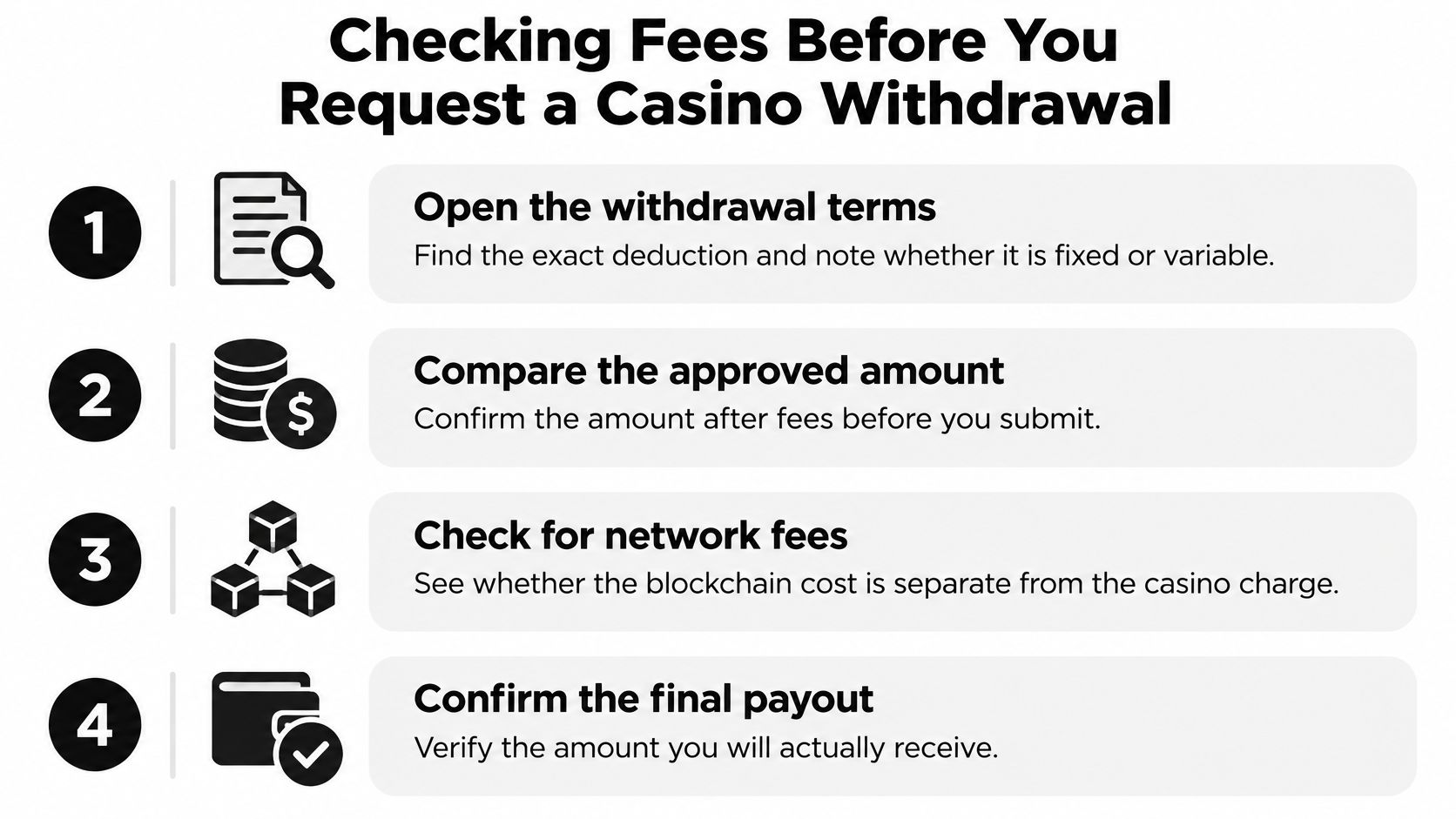
A practical withdrawal checklist
Record the quoted deduction. Save whether the charge is fixed or variable. Also record the approved amount before submission, so you can reconcile it with the final receipt and identify which deduction came from the operator.
Confirm the asset and network. Check that the receiving wallet supports the selected route, including the specific network used for a stablecoin payout.
Check the withdrawal limits. Read the minimum and maximum amounts, along with any bonus-related withdrawal restrictions, before submitting. Another player's result does not establish the limits on your account.
Review verification requirements. Identity or payment-ownership checks can affect a first withdrawal. FastCashout's guide, “The first withdrawal can be different,” explains these checks and how they may add time.
Preserve transaction evidence. After the transaction is broadcast, use its transaction ID and confirmation status to check the network explorer. A cashier status alone does not show the transaction's full progress.
Reading the result responsibly
FastCashout's guide, “What a withdrawal time really measures,” explains the steps between a request and money arriving. Separating review, transaction release, and network settlement helps you identify where time was spent instead of attributing every delay to crypto fees.
A completed withdrawal does not establish an overall gambling profit. Record the charge alongside the amount received, and do not use additional gambling to try to recover a withdrawal fee.
FastCashout provides reported withdrawal records, evidence context, and explanations of operator processing and blockchain settlement. Adult readers can visit FastCashout to compare payout information and check which fees are documented, which claims are unverified, and which conditions may affect a later request.